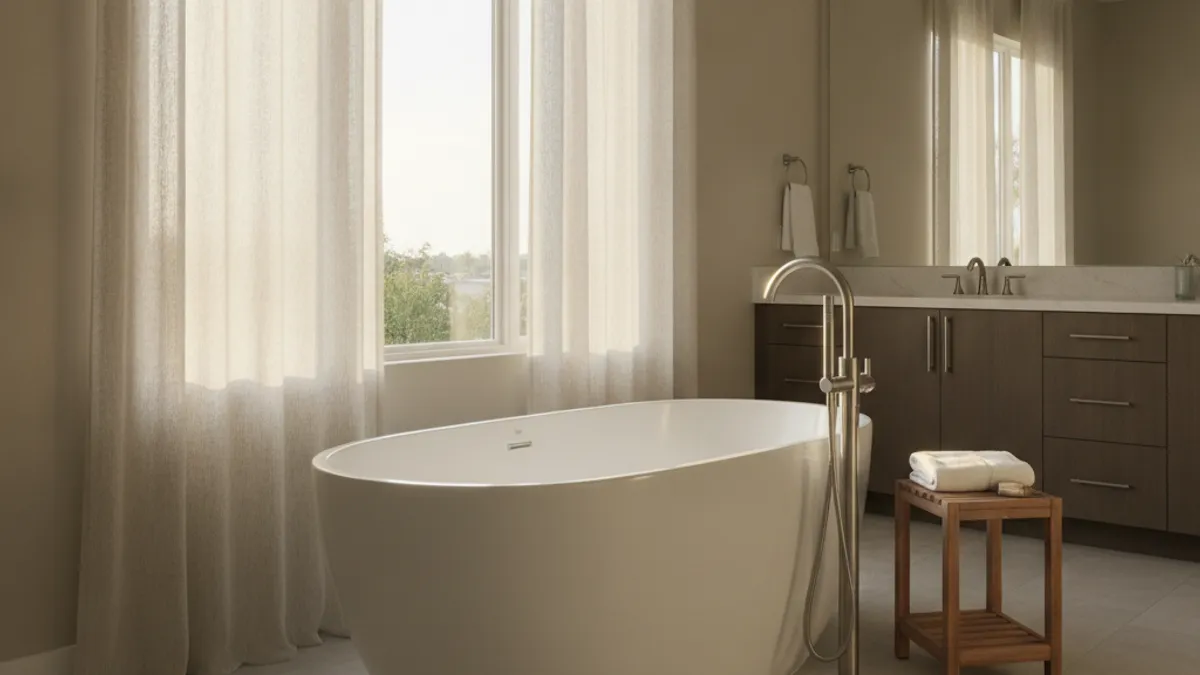
Why the tub is making a quiet comeback in Tampa Bay master baths
For the last decade, the conventional wisdom in Tampa Bay bath remodels was to convert the tub to a walk-in shower. The logic was simple: most homeowners use the shower 95% of the time, the tub is wasted floor space, and a curbless shower reads as modern. The wisdom held for hall baths and guest baths. For master baths, it underserves households with kids, with dogs, with aging parents who still soak, and with resale-conscious owners who know that a single-tub master in a $900K FishHawk Ranch or New Tampa home is a buyer turn-off.
A clean bathtub installation in a Tampa Bay master bath solves four problems at once: it gives the household a real soaking tub (not a leftover 60-inch alcove), it pairs with a separate walk-in shower in a true primary suite, it makes the master feel like a primary suite, and it costs less than most homeowners expect. A standard alcove tub install runs $1,600-$4,000. A freestanding acrylic tub install runs $3,200-$6,800. A cast iron freestanding tub install runs $5,000-$10,500 with the floor reinforcement, when it applies.
This is a walk through the tub types, the install decisions that matter, and what the project actually costs.
The four tub types, ranked
Alcove tub. A 60-inch drop-in alcove tub is the most common tub in 1950s-1990s Tampa Bay concrete block homes. The tub drops into a three-wall pocket, the wet wall is tiled or paneled, and a glass shower door or curtain rod closes it in. A new alcove tub with a tile surround, a new valve, a new waste-and-overflow, and a glass door runs $2,500-$5,800 installed. The right call for a hall bath or a kid’s bath.
Drop-in tub. A drop-in tub sits in a framed surround (tile, stone, or paneled wood) with the tub rim resting on the surround deck. Drop-ins are common in older master baths and in custom remodels where the surround is part of the design. A drop-in install runs $3,200-$7,600 with a tile surround and a new valve.
Freestanding acrylic tub. A freestanding acrylic tub is the right call for most Tampa Bay master bath remodels in 2026. It is light enough to install on a standard ground-floor slab or an upper-floor subfloor without special reinforcement (60-90 pounds for the tub itself, plus the water weight), it comes in a range of shapes (slipper, double-slipper, oval, rectangular), and it lands at $1,200-$3,200 for the tub plus $1,800-$3,600 for install, valve, and filler. Total $3,200-$6,800.
Cast iron freestanding tub. A cast iron tub is the heavyweight option at 250-400 pounds empty. On a ground-floor bath poured on a concrete slab, the slab handles the load with no extra work. On an upstairs bath in one of Tampa Bay’s growing number of two-story homes, the floor often needs reinforcement before install. The payoff is heat retention (a cast iron tub holds water temperature 2-3 times longer than acrylic) and a finish that lasts 30+ years. A cast iron install runs $5,000-$10,500 including any needed floor reinforcement, valve, and filler.
Soaking tub. A soaking tub is a deeper version of an alcove, drop-in, or freestanding tub, with a typical depth of 18-24 inches versus the standard 14-16 inches. Soaking tubs work in any of the four install types, and the right call is a freestanding acrylic or a Japanese-style deep soaking tub.
The bathtub installation page has the line items for each install type, and the freestanding tub angle is on the master bathroom remodel page for primary suite design.
The valve, waste-and-overflow, and filler decisions
Three plumbing decisions define how a tub install feels.
The valve. A pressure-balancing tub valve is the code minimum and runs $110-$270. A thermostatic valve with a separate volume control runs $360-$820 and is the right call for a master bath where two people might use the tub in the same evening. Most Tampa Bay installs use a single-handle pressure-balance valve with a diverter spout for the shower, and a separate valve is reserved for higher-end master baths.
The waste-and-overflow (WO). The WO is the tub drain and the overflow plate. A plastic WO runs $28-$70 and works for an alcove tub with a tile surround. A brass WO with a toe-tap drain runs $110-$270 and is the right call for a freestanding tub where the WO is visible. A push-to-close or toe-tap drain is a $35-$80 upgrade over a traditional lift-and-turn. In homes near the Gulf, ask for a solid brass or stainless WO and hardware, not a chrome-plated pot metal fitting; the salt air along the coastal parts of Pinellas County corrodes cheaper plating faster than it will inland.
The filler. A deck-mount tub filler on the surround deck is the standard for an alcove or drop-in tub and runs $180-$620. A wall-mount tub filler on the wet wall is the standard for a freestanding tub and runs $270-$800. A floor-mount tub filler next to a freestanding tub is the design move that finishes a high-end master and runs $620-$1,600. The right filler depends on the tub, the surround, and the design intent.
The bathroom plumbing page has the rough-in line items, including valve, WO, and filler specs.
Floor considerations for a heavy tub
A cast iron tub at 300+ pounds empty, plus 50-80 gallons of water at 8.3 pounds per gallon, plus a 200-pound bather, loads the floor at 1,000+ pounds concentrated in a 6-square-foot footprint. Most Tampa Bay homes are single-story and sit on a poured concrete slab, which handles this load without modification. The floor question comes up on the second story of a two-story home, where the upper floor is framed with wood joists or engineered trusses over the ground-floor slab.
Floor reinforcement options for an upstairs primary suite:
- Sister the existing joists with a second joist glued and screwed to the side, increasing the load capacity by 60-80%. Runs $350-$800 in labor and material.
- Add a perpendicular beam under the tub location, supported from below where structurally possible. Runs $700-$1,600.
- Add blocking and additional fastening at the tub footprint to distribute the load across more of the floor system. Runs $300-$700.
The right call depends on the joist or truss size, the span, and the tub weight. A good crew will not install a cast iron tub on an upstairs bath without checking the floor structure first. The master bathroom remodel page has the structural decision line items for a primary suite expansion.
Surround, deck, and paneling choices
The surround is the surface around an alcove or drop-in tub. Five common choices in Tampa Bay remodels:
- Tile (porcelain or ceramic) on a cement board or foam backer. Most common, most durable, easiest to match to a shower. Runs $7-$22 per square foot installed.
- Solid surface (Corian or equivalent) panels. Smooth, easy to clean, reads as modern. Runs $35-$70 per square foot installed.
- Cultured marble or engineered stone panels. Mid-range price, mid-range durability, available in slab and tile patterns. Runs $22-$45 per square foot installed.
- Acrylic or fiberglass surround panels. Cheapest, fastest install, lowest durability. Runs $13-$26 per square foot installed.
- Natural stone (marble, travertine, slate). Highest end, highest maintenance, needs sealing twice a year and holds up less well against Tampa Bay’s harder water. Runs $35-$90 per square foot installed.
For most Tampa Bay master bath remodels, tile on a foam backer board is the right call. It matches a tile shower, it lasts 25+ years, it handles the humidity, and it can be repaired one tile at a time if something goes wrong.
The bathroom tile page has the surround and floor tile line items, including waterproofing methods for a wet zone over a tub.
What a Tampa Bay tub install actually costs
A standard alcove tub replacement in a Tampa Bay hall bath runs $1,600-$4,000 for the tub, valve, WO, and basic install. With a tile surround, a glass door, and a new shower valve, the project lands at $3,200-$6,800. A freestanding acrylic tub install with a wall-mount filler and a brass WO runs $3,200-$6,800. A cast iron freestanding install with floor reinforcement (if needed), a wall-mount filler, and a brass WO runs $5,000-$10,500.
The line items for a typical freestanding install:
- Tub (acrylic, 60-66 inches): $1,200-$3,200
- Tub filler (wall-mount): $270-$800
- Brass waste-and-overflow: $110-$270
- Plumbing rough-in and valve: $1,100-$2,200
- Floor reinforcement (if needed): $300-$1,600
- Install labor: $900-$1,900
- Permits: $170-$500
For most projects, the tub itself and the filler are the line items that move the budget. A mid-range acrylic tub with a mid-range wall-mount filler lands in the mid-range. A cast iron tub with a floor-mount filler climbs to the high end.
What to ask a tub install contractor
Three questions separate a clean tub install from a corner cut:
- Have you checked the floor structure for a cast iron tub on an upstairs bath? A single-story bath on a slab usually needs no reinforcement; an upstairs bath in a two-story home often does. The honest answer depends on the framing.
- Is the plumbing rough-in showing a valve specification, a WO material, and a filler specification? A quote that says “tub install” with one number is missing the parts that drive cost.
- What is the warranty on the install? A 1-year warranty on labor is standard. A 5-year or 10-year warranty is a sign of a crew that has been doing this long enough to stand behind the work.
A good crew will not flinch at any of these questions. For the full master bath scope that often pairs with a tub install, the master bathroom remodel page has the line items and the project timeline.
Call (813) 000-0000 to set up a free in-home consult. We measure the bathroom, check the floor, and tell you whether an alcove, freestanding, or cast iron tub is the right call, and what the install actually costs.