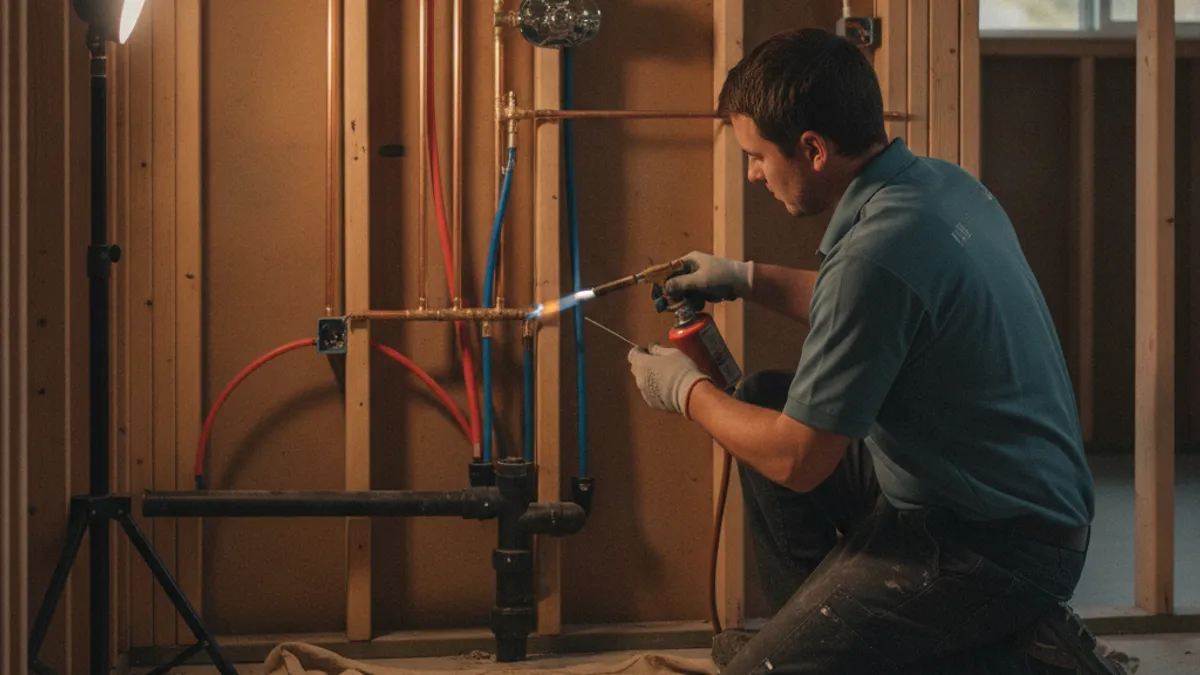
Why the plumbing rough-in is the line item most often under-scoped
A bathroom plumbing rough-in is the work the homeowner never sees, and it is the work that fails first if it is done wrong. A clean rough-in solves four problems: it puts the fixtures in the right location, it sizes the supply and drain lines for the fixtures, it integrates with the vent stack properly, and it passes the rough inspection the first time. The rough-in is also the most common place a corner-cut bathroom remodel saves $1,300-$2,800 by reusing old galvanized supply lines, capping old drains, or skipping the pressure-balancing valve.
A clean Tampa Bay bathroom rough-in runs $4,000-$8,000 for a typical 40-65 square foot bath, depending on whether the drain needs to move, whether the supply lines are being replaced, and whether the vent stack is being reworked. The cost runs higher than a same-scope job in a wood-framed home because most Tampa Bay houses sit on a concrete slab, and any drain move means saw-cutting and re-pouring the slab, not just reframing a floor. The cost is worth it because the rough-in is the work that has to be opened up again if it fails, and that means tile, drywall, and paint on the redo.
This is a walk through the supply line decision, the drain and vent decision, the valve and fixture decisions, and what a Tampa Bay bath rough-in actually costs.
The supply line decision: copper, PEX, or keep what is there
Most pre-1990 Tampa Bay tract homes have galvanized steel supply lines, and some homes built between the late 1970s and early 1980s used polybutylene, which is prone to failure and worth replacing on sight if it turns up during demo. Galvanized lines corrode from the inside, the inside diameter shrinks over 30-40 years, and the corrosion shows up as low pressure at the fixtures, rust-colored water in the morning, and pinhole leaks in the wall. The right call for any bath remodel in a pre-1990 home is to replace the galvanized (or polybutylene) lines with new supply lines from the manifold (or the main) to the bath.
Three supply line materials are common in Tampa Bay in 2026:
- PEX (cross-linked polyethylene). The most common in residential remodels. PEX is flexible, comes in long rolls, requires fewer fittings, and resists the mineral scale buildup that shows up with Tampa Bay’s moderately hard groundwater. PEX runs $0.50-$1.40 per linear foot for the material and $4-$7.50 per linear foot installed.
- Copper (Type L). The traditional choice for higher-end remodels. Copper is rigid and has a long service life. Copper runs $2-$4.50 per linear foot for the material and $7.50-$16 per linear foot installed. The right call for a homeowner who prefers copper.
- CPVC (chlorinated polyvinyl chloride). The budget choice. CPVC is rigid, comes in 10-foot lengths, and is joined with solvent cement. Allowed under the Florida Building Code, Plumbing but less common in Tampa Bay remodels than PEX. CPVC runs $0.50-$1.10 per linear foot for the material and $4.50-$9 per linear foot installed.
The repipe line items are on the bathroom plumbing page.
The drain and vent decision
The drain and vent system is the most code-intensive part of a bath rough-in. The rules that matter for a Tampa Bay bath:
- Drain sizing. A shower drain is 2 inches. A tub drain is 1.5 inches. A vanity drain is 1.5 inches. A toilet drain is 3 or 4 inches. The main soil stack is 4 inches. All drains must slope at 1/4 inch per foot toward the stack.
- Vent sizing. A vent must rise vertically from the drain trap and connect to the stack at least 6 inches above the flood rim of the highest fixture on the floor. A wet vent is allowed in some configurations.
- Vent stack sizing. A 2-inch vent stack serves up to 8 fixture units on a residential bath. A 3-inch or 4-inch vent stack is required for larger homes.
- Cleanouts. A cleanout is required at the base of the stack and at any change of direction more than 45 degrees.
The wrong call is reusing a 1.5-inch drain on a shower that needs a 2-inch drain, or skipping the vent on a vanity move. The right call is to size every drain and vent per the Florida Building Code, Plumbing and to call for a rough inspection before closing the wall (or before pouring back the slab, on a ground-floor bath).
The bathroom plumbing page has the rough-in line items, including the drain moves, the vent stack work, and the cleanout locations.
The valve and pressure-balancing decision
A pressure-balancing valve is required under the Florida Building Code, Plumbing on every shower and tub-shower valve. The valve prevents scald by balancing the hot and cold pressure when a toilet is flushed, a dishwasher starts, or a washing machine fills. A standard pressure-balance valve runs $75-$180 for the rough and $40-$90 for the trim.
A thermostatic valve is the upgrade that holds the water temperature to within 1 degree regardless of pressure swings. A thermostatic valve runs $225-$550 for the rough and $90-$270 for the trim, for a total of $315-$820. The right call for a master bath, a kid’s bath, or any bath with a user who is sensitive to temperature changes.
A volume control valve is the third piece, and it is required for any shower with multiple outlets (a fixed showerhead plus a hand shower, for example). A volume control valve runs $75-$180 for the rough and $40-$90 for the trim.
The wrong call is to use a single-handle “shower only” valve that does not have a pressure-balance cartridge. The wrong call also includes using a 1/2-inch valve on a shower that should have a 3/4-inch valve (the 1/2-inch valve restricts flow and shows up as a weak shower).
The pressure balancing valve line items are on the bathroom plumbing page.
Drain moves: when they are needed and what they cost
A drain move is the most common surprise in a Tampa Bay bath rough-in, and it is a bigger job here than in a home with a raised wood floor, because most bathrooms sit on a concrete slab. The original tub drain at the front of the wet zone has to move to the back of the wet zone for a curbless shower with a linear drain. The original toilet drain has to move if the layout is being reworked. The original vanity drain has to move if the vanity is being relocated to a different wall. Every one of these moves means saw-cutting the slab, trenching, running new drain line, backfilling, and re-pouring concrete before tile goes back down.
Drain move costs in a typical Tampa Bay bath, slab-cutting included:
- Tub drain to a shower drain at the back wall. $1,600-$3,200.
- Toilet drain to a different wall. $1,900-$4,200.
- Vanity drain to a different wall. $500-$1,100.
- Vent stack re-route. $1,800-$4,000.
For most Tampa Bay bath remodels, the drain move is the line item that moves the budget the most. A like-for-like remodel with no drain move lands at the low end of the rough-in range. A layout change with a drain move lands at the high end.
The common Tampa Bay bath rough-in problems
Five recurring problems show up in older Tampa Bay bath rough-ins:
1. The cast iron drain stack is corroded at the base. A 1950s-1960s home in Seminole Heights, Old Northeast, or Gulfport often has a cast iron stack that is corroded at the base. The fix is to cut out the corroded section and replace it with PVC, and the work is $1,400-$3,200 if it is accessible.
2. The galvanized supply lines are partially blocked. A pre-1980 home with original galvanized lines often has 50-70% blockage in the horizontal runs. The fix is to replace the galvanized with PEX or copper from the manifold to the bath, and the work is $1,800-$4,000.
3. The vent stack is undersized. An older home may have a 1.5-inch vent stack serving a bath that needs a 2-inch or 3-inch vent. The fix is to upsize the vent, and the work is $700-$1,800.
4. The toilet drain runs uphill under the slab. A slab-on-grade home with a toilet drain that runs uphill at any point will not pass rough inspection. The fix is to re-route the drain, which on a slab means cutting a wider trench to correct the slope.
5. The shower drain is not centered on the shower footprint. A shower drain that is off-center by 2-3 inches will not pass rough inspection in some jurisdictions. The fix is to re-route the drain.
A clean rough-in addresses all five of these issues during the design phase, not during the rough-in. The bathroom plumbing page has the rough-in checklist.
What a Tampa Bay bath rough-in actually costs
A typical 40-65 square foot Tampa Bay bath rough-in runs $4,000-$8,000. A layout change with a drain move runs $6,000-$11,000. A full repipe from the manifold to the bath runs $1,800-$4,000 in addition to the rough-in.
The line items for a typical rough-in:
- New supply lines (PEX or copper, 30-60 linear feet): $1,000-$2,500
- New drain lines (PVC, 20-40 linear feet): $1,100-$2,200
- Slab-cutting, trenching, and patching (if a drain moves): $900-$2,600
- Pressure-balance or thermostatic valve (rough and trim): $180-$820
- Volume control valve (if needed): $115-$270
- Vent stack work (if needed): $700-$1,800
- Cast iron stack replacement (if needed): $1,400-$3,200
- Rough inspection fee: $130-$350
For most projects, the supply line replacement and the valve upgrade are the line items that move the budget the most. A PEX rough-in with a pressure-balance valve lands at the low end. A copper rough-in with a thermostatic valve and a drain move climbs to the high end.
What to ask a bath plumbing contractor
Three questions separate a clean rough-in from a corner cut:
- Are you replacing the supply lines from the manifold (or main) to the bath, or are you reusing the existing galvanized or polybutylene? The honest answer depends on the age of the home, but the right call for most pre-1990 homes is replacement.
- Is the pressure-balance or thermostatic valve in the rough-in line, or is it a separate line item? A quote that says “shower valve” with one number is missing the rough and the trim.
- Will you call for a rough inspection before the wall (or slab) is closed? The contractor, not the homeowner, and the inspection should be on the schedule before the drywall goes up or the concrete gets poured back.
A good crew will not flinch at any of these questions. For the full bath scope that pairs with a rough-in, the full bathroom remodel page has the line items and the project timeline. In a condo, the stack behind that wall may not be yours to move at all, which is what the condo bathroom remodel rules for Tampa Bay walk through.
Call (813) 000-0000 to set up a free in-home consult. We look at the existing supply lines, the drain stack, the slab, and the planned layout, and we connect you with an insured local plumbing crew for a written scope on the plumbing side of the bath remodel with a real budget. Verify any Florida plumbing contractor’s license at myfloridalicense.com before signing.