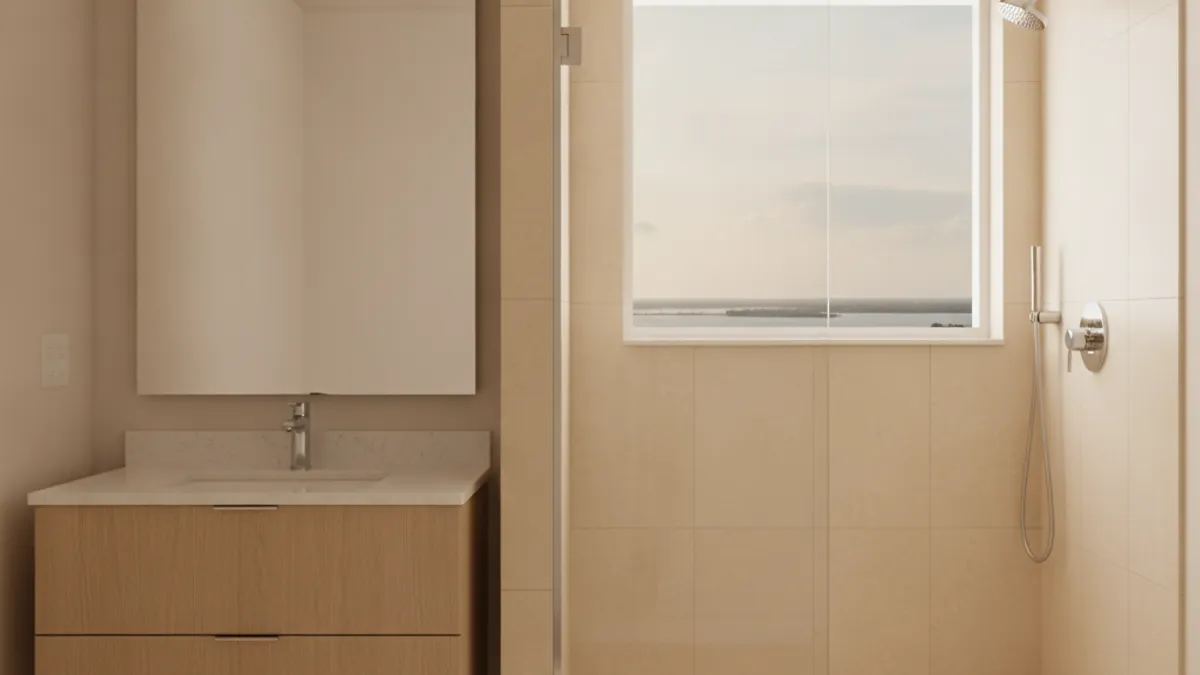
Condo bathroom remodel rules in Tampa Bay come down to one line drawn in your recorded declaration. The finishes and fixtures that serve only your unit sit on your side of it. The plumbing that runs through your wall to serve other units can be a common element under Florida law, which is why moving a drain and swapping a vanity aren’t the same request to your board. Board approval and a building permit are two different approvals from two different bodies, and depending on the scope a condo bath can need both.
What do condo bathroom remodel rules in Tampa let your association control?
Your association controls the common elements, and the recorded declaration tells it where those start.
Florida Statutes section 718.103(31) defines a unit as property under exclusive ownership, with its boundaries specified in the declaration.
Florida Statutes section 718.108(1)(a) then defines common elements to include “The condominium property which is not included within the units.”
Read those two together and the shape of the rule is simple. Whatever the declaration didn’t put inside your unit is common element, and that’s the part the board controls.
That line matters the moment you plan a full bathroom remodel. Swapping finishes inside the unit is a different animal from cutting into a shared stack.
Under Florida Statutes section 718.113(1), the association maintains the common elements, though a declaration can hand certain limited common-element duties back to the unit owner.
So a board’s authority tracks the work, not the room. Replacing a vanity isn’t the same request as moving a shared plumbing connection, and it shouldn’t get the same answer.
Where is the line between your unit and common elements?
Your declaration draws it, and no two buildings draw it the same way.
Florida Statutes section 718.103(31) says the declaration specifies each unit. Section 718.103(22) says the declaration also identifies the limited common elements, the ones reserved for certain units to the exclusion of all the others.
Those stay common elements even though only your unit uses them. The declaration can still hand you the job of maintaining them.
Shared utility infrastructure gets its own treatment in Florida Statutes section 718.108, which counts installations serving more than one unit or the common elements as common elements too.
That’s why there’s no statewide answer to “where does my bathroom end.” There’s only your building’s answer. Before you move a shower or a toilet, read these:
- The declaration and its recorded amendments
- The bylaws and current alteration rules
- The unit-boundary description
- Any contractor or construction application
- The building’s limited common-element provisions
Together they answer “can I move my shower” better than anyone on the phone can. It comes down to the declared boundary and which plumbing you’d be touching.
One note before we go further. This is general information, not legal advice, and your building’s declaration and bylaws control its own approval process.
Do condo bathroom remodel rules require an owners’ vote?
No. Florida law doesn’t put a building-wide vote in front of every bathroom remodel.
Florida Statutes section 718.113(2)(a) is about material alterations or substantial additions to the common elements. For that work, the declaration supplies the approval procedure.
If the declaration doesn’t specify one, the statute steps in and requires 75 percent of the total voting interests to approve before the work starts. That default is tied to common-element alterations.
It isn’t a blanket vote on work inside your unit. Replacing a vanity in your own bathroom isn’t automatically a common-element alteration, so don’t go looking for a ballot you don’t need.
Change shared property and the answer can shift. Your declaration can also set up its own review for elective interior work, which is a separate hurdle from the statute.
So don’t let the word “interior” settle it. Check whether the scope crosses the recorded unit boundary, then ask.
Why can moving a shower drain cross the property boundary?
Because the drain you want to move may be serving the units above and below you.
Florida Statutes section 718.108(1)(b) counts easements through units for plumbing and other utility facilities as common elements. Section 718.108(1)(d) counts the installations required to serve more than one unit.
So a shared stack isn’t yours just because it runs through your wall. Move it, and you’ve moved a common element.
That’s why so many Tampa Bay condo baths stay inside the existing wet wall. It isn’t a design preference, it’s the boundary.
A bathroom design plan should nail down the plumbing changes before anyone picks tile. Then the pro you’re matched with can hold that scope up against your association’s documents.
On a tight footprint, these small bathroom remodel ideas are worth a read, as long as you check which layout moves your building allows.
Does board approval replace a building permit?
No. Your board and your building department are two different offices, and clearing one doesn’t clear the other.
The City of Tampa lists kitchen and bathroom remodels as residential alterations that need a permit. It also says plans aren’t required for minor remodeling work or minor plumbing, electrical, and mechanical repairs.
Floor coverings, painting, wallpapering, cabinetwork, furnishings, decorations and shelving don’t need a City of Tampa building permit at all. Ordinary minor repairs have a hard limit, though: they can’t involve cutting away a wall or partition, removing or cutting a structural beam or load-bearing support, or changing a required means of egress.
City applications run through the Accela Citizen Access portal. One thing condo owners should catch early: the city’s residential permit program covers single-family residences and duplexes, so confirm the right application path for your building before anyone files.
Out in unincorporated Hillsborough County, everything goes through HillsGovHub. Its cosmetic exemptions cover painting, tile, floor coverings, shelving, cabinet work and wallpapering.
The county’s plumbing exemption is much narrower than people expect. It covers removing and reinstalling a water closet, and only when the repairs don’t replace or rearrange pipes or other fixtures.
There’s also an HB 803 exemption for non-structural work on a single-family residence valued under $7,500. It doesn’t reach electrical, plumbing, structural, mechanical or gas work, and it doesn’t apply in a flood hazard area.
For a residential alteration with no structural work, the county wants a floor plan showing the existing and proposed scope. A homeowner acting as their own contractor also has to complete an Owner Builder Disclosure Statement.
Then there’s the paperwork most people forget. Hillsborough County requires a Notice of Commencement on improvements over $5,000, recorded and certified at the Clerk’s office and uploaded to HillsGovHub. A condo bath clears $5,000 easily.
The pro you’re matched with pulls the permits that apply. It’s worth walking through bathroom plumbing services before you commit to moving any fixture.
Who insures the tile and vanity after installation?
You do, and the statute says so by name.
Florida Statutes section 718.111(11)(f)3. requires the association’s property policy to exclude a specific list of things inside your unit. That list opens with floor, wall and ceiling coverings.
It keeps going: electrical fixtures, appliances, water heaters, water filters, built-in cabinets and countertops, and window treatments, where those are inside the unit boundaries and serve only that unit. The statute says that property, and the insurance on it, is the unit owner’s responsibility.
Read that list next to a bathroom scope and it’s almost the same document. Your tile, your vanity cabinet, your countertop, your vanity lights. All of it lands on your policy, not the building’s.
Board approval doesn’t move that line either. Before demo starts, put the finished scope next to your own policy and see what it actually covers.
Can the association enter your unit during the work?
Yes, and Florida law is specific about when.
Florida Statutes section 718.111(5)(a) gives the association an irrevocable right of access to each unit during reasonable hours, when it’s necessary to maintain, repair or replace any common element.
That right also covers any portion of a unit the association maintains under the declaration, and it covers access needed to prevent damage to a common element or to another unit.
That’s worth knowing before demo day. Once a wall comes open and a shared stack is exposed, the association can have a lawful reason to be in the room, so plan the schedule around it rather than treating it as an interruption.
How do milestone inspections affect the approval conversation?
They put the building’s structure under a formal review your board has to answer for.
Florida Statutes section 553.899(3)(a) covers buildings that are three habitable stories or more in height, under the condominium or cooperative form of ownership. Those buildings need a milestone inspection by December 31 of the year the building turns 30, measured from the date its certificate of occupancy was issued, and every 10 years after that.
The second trigger is the one that’s easy to get backwards. Florida Statutes section 553.899(3)(b) lets the local enforcement agency decide that local circumstances, including proximity to salt water, call for a 25-year trigger instead.
The word in the statute is “may.” A 25-year inspection is a determination your local agency is permitted to make, not a statewide rule that every coastal condo gets inspected at 25.
Section 553.899(2)(a) also draws a line around what the inspection is for. In the statute’s own words, “The purpose of such inspection is not to determine if the condition of an existing building is in compliance with the Florida Building Code or the firesafety code.”
None of this blocks an interior remodel. It’s context worth having when you submit a scope, because a building working through a milestone cycle has a structural review running alongside your project.
What does a condo bathroom remodel cost in Tampa Bay?
It depends on where the building is and how much of the bath you’re actually touching. Here’s what this site already publishes, city by city.
- The Westshore Marina District bathroom remodel page lists $12,000 to $25,000 for a condo refresh with a fixed footprint.
- The Clearwater Beach bathroom remodel page lists $22,000 to $40,000 for a standard condo bathroom.
- The St. Pete Beach bathroom remodel page lists $22,000 to $38,000 for a standard condo bathroom.
- The Treasure Island bathroom remodel page lists the same $22,000 to $38,000 band.
- The Madeira Beach bathroom remodel page also lists $22,000 to $38,000.
Don’t average those into one metro number, because they aren’t describing the same job. Westshore’s figure is a refresh with the footprint locked. The beach-city figures are standard condo baths in buildings where access and salt-air-rated materials are part of the spec.
Scope is what you compare first, then location. Read the fuller Tampa bathroom remodel cost guide next to your own building’s requirements and the gap between the two usually explains itself.
Frequently asked questions
Do I need written association approval before demolition?
Your declaration and your building’s alteration rules decide that, so read both before you schedule anything. Get whatever approval they call for in writing before demo touches the unit or a common element.
And board approval still doesn’t stand in for a building permit. Keep both processes pointed at the same final scope.
Can I replace bathroom tile without a permit?
Cosmetic tile work is permit-exempt in both the City of Tampa and unincorporated Hillsborough County. Your association can still want notice or approval under its own documents, and that’s a separate question from the permit.
Pulling tile also doesn’t give you a free hand with plumbing or structure. Keep that work listed separately in whatever scope you submit.
Can I replace a toilet without changing the plumbing?
Unincorporated Hillsborough County does exempt removing and reinstalling a water closet, but only when the repairs don’t replace or rearrange pipes or other fixtures. Move the drain and you’re outside it.
Your association’s documents still govern anything that reaches a common element. Check both before the first fixture comes out.
Does every condo bathroom remodel require a 75 percent vote?
No. That 75 percent default is about material alterations or substantial additions to the common elements, and it only applies when the declaration doesn’t set out its own procedure.
It isn’t a vote on every bathroom update. For common-element alterations, your declaration supplies the process first.
Does post-loss reconstruction follow the same approval rule?
It has its own provision. Florida Statutes section 718.111(11)(g)1. says a unit owner may undertake reconstruction work on portions of the unit with the prior written consent of the board, and that the board can condition it on the repair methods, the contractor’s qualifications, or the contract itself. It also says the owner must obtain all required governmental permits and approvals before starting.
Worth being precise here: that paragraph sits inside the insurance subsection and governs reconstruction after a property loss. It isn’t the statutory authority for board sign-off on an elective remodel, and treating it that way misreads the statute.
Who pulls the permit for a matched project?
The licensed, insured local pro does, and the homeowner contracts with and pays that contractor directly.
Tampa Bathroom Pro is a referral service. We match homeowners with licensed, insured local bathroom pros across Hillsborough, Pinellas and Pasco counties, and the pro pulls the permits the job calls for.
Start with the full bathroom remodeling service or the small bathroom remodeling service. Bring your declaration, your alteration rules and your proposed scope to the first conversation, and you’ll get a straighter answer than any general guide can give you.